Pain and recovery
K-Laser therapy explained: how it works, what it helps and what to expect
K-Laser therapy explained — how Class IV laser (photobiomodulation) works, the conditions it helps, what a session feels like, the evidence and when it's used in Potters Bar.
K-Laser therapy is a Class IV therapeutic laser treatment that uses far-red and infrared light to reduce inflammation and support tissue healing. It is increasingly offered alongside hands-on care for back, neck and joint pain — but with so much marketing around "laser treatment", it can be hard to work out what it actually is, what the evidence says and whether it is worth trying. This guide explains how it works, what a session involves, who it may help and where its limits are.
What is K-Laser therapy?
K-Laser is a brand of Class IV (high-power) therapeutic laser. Unlike surgical lasers, it does not cut, burn or ablate tissue. It delivers specific wavelengths of far-red and infrared light through the skin and into the underlying muscles, tendons, ligaments and joints.
The treatment itself is a form of photobiomodulation — the use of light energy to stimulate a biological response in cells. The wavelengths are chosen so that the light is absorbed by structures inside the cells (particularly in the mitochondria, the cell's energy factories), which increases cellular energy production. That extra energy supports the processes involved in repair and helps calm inflammation in the treated area.
How does it differ from other laser treatments?
- Class IV vs "cold laser". Older low-level laser devices (Class III, often called cold laser) deliver very little power and treat only shallow tissue. Class IV lasers deliver enough energy to reach deeper muscles and joints in a shorter treatment time.
- Therapeutic vs surgical. Surgical lasers cut or remove tissue. Therapeutic lasers like K-Laser do neither — the goal is to stimulate healing, not to operate.
- Not a light "vibe" device. The treatment parameters — wavelength, power density and dose — are set for the tissue being treated. Holding a consumer red-light gadget over skin is not the same intervention.
What does a session feel like?
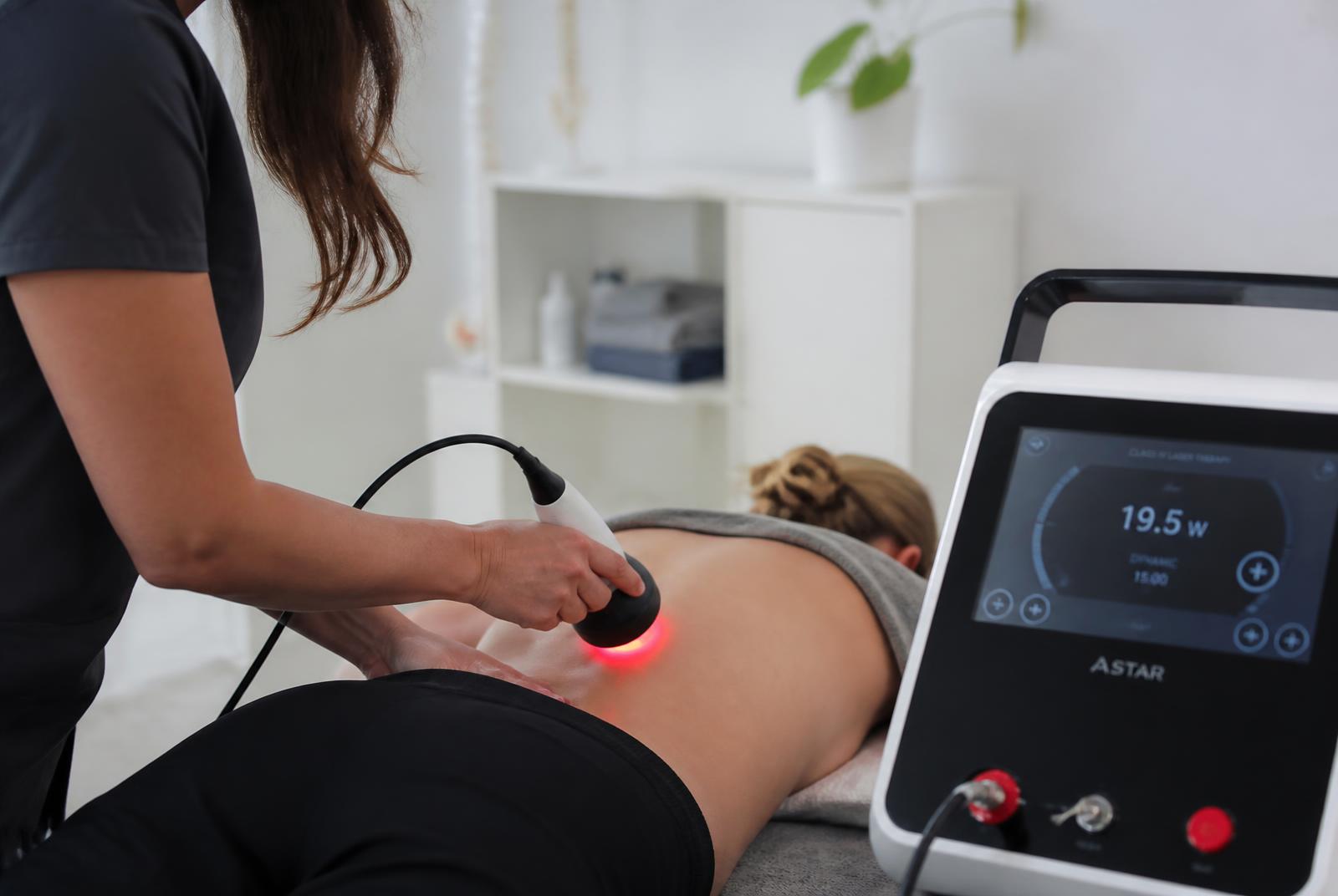
Most people feel a soothing, gentle warmth over the area being treated. The laser handpiece is moved continuously over the skin — it is held against the skin or just above it, so there are no needles and nothing touches the painful tissue directly. Sessions are short and there is no recovery downtime: you can drive, work and exercise as usual immediately afterwards. Occasional mild, short-lived soreness similar to post-exercise aching can occur.
What conditions is K-Laser used for?
Photobiomodulation is used to support recovery where inflammation and slow-healing tissue are part of the picture. At Potters Bar Spine Clinic it is most often applied to:
- Chronic back and neck pain that has not fully settled with other approaches.
- Sports and soft-tissue injuries — muscle tears, ligament sprains and slow-healing tendon problems.
- Arthritic and joint pain, where reducing inflammation in and around the joint can ease stiffness.
- Nerve-related pain such as sciatica, where easing inflammation around an irritated nerve is one part of a wider programme.
- Post-surgical recovery, to support tissue repair once a surgeon is happy for treatment to begin.
What does the evidence say?
Photobiomodulation has a genuine research base — studies and systematic reviews suggest it can reduce pain and inflammation in a range of musculoskeletal conditions, particularly tendinopathy and neck pain. However, study quality varies, results differ between conditions and individuals, and no laser treatment is a cure-all.
At this clinic we take a straightforward view: K-Laser is a useful adjunct — a way to reduce inflammation and support tissue repair while the more important work of restoring movement, strength and load tolerance happens around it. It is never sold as a standalone fix, and it does not replace assessment, hands-on treatment or rehabilitation. It cannot reposition a disc or "melt" an injury away, and it is not a substitute for urgent medical assessment of serious nerve problems.
What to expect from a course of treatment
A session is short — the laser component is typically applied within your normal treatment appointment, after assessment and hands-on work. Because photobiomodulation is cumulative, a short course of sessions over a few weeks is usually recommended rather than a single treatment, with the plan reviewed against your symptoms. Many people notice reduced pain and easier movement within the first few sessions; others notice gradual change over the course. How long the condition has been present, its severity and your general health all affect the response.
Are there side effects or reasons not to have it?
Class IV therapeutic laser is well tolerated: it is non-invasive, drug-free and has no known interaction with medication. The main sensible precautions are straightforward — the laser is never applied directly over the eyes, over a pregnancy bump, over active cancer sites or over areas of suspected serious pathology. Your practitioner screens for these during the assessment, which is one reason a professional assessment comes before any laser course.
How does it fit with osteopathic treatment?
In practice the sequence matters. A full assessment identifies what is actually driving your pain — a stiff segment, a restricted joint, an overloaded tendon or an irritated nerve. Hands-on treatment restores the movement it can, the laser reduces inflammation in the tissue that needs it, and a graded exercise programme rebuilds capacity so the improvement holds. Treating the symptom alone — with laser or anything else — leaves the cause in place.
You can read more about K-Laser therapy at the clinic, or see how this fits into care for sciatica and slipped discs and recovering from a running injury.
Sources and further reading
- NICE NG59: Low back pain and sciatica in over 16s
- PubMed: research on photobiomodulation for musculoskeletal pain
This guide provides general information, not a diagnosis or an individual treatment plan. Suitability for K-Laser therapy is always decided as part of a personal assessment.